

AI writes. Who vouches for it? The new axis of Software Engineering
A Harvard study of 655 firms shows that AI multiplies code but not delivery: the bottleneck moved to code review. What this changes for Software Engineering students at UnB — with the slide deck and infographic used in class.
This piece was originally written in Portuguese. Below is a summary; the full text is available only in its original language.
Read the original textSummary
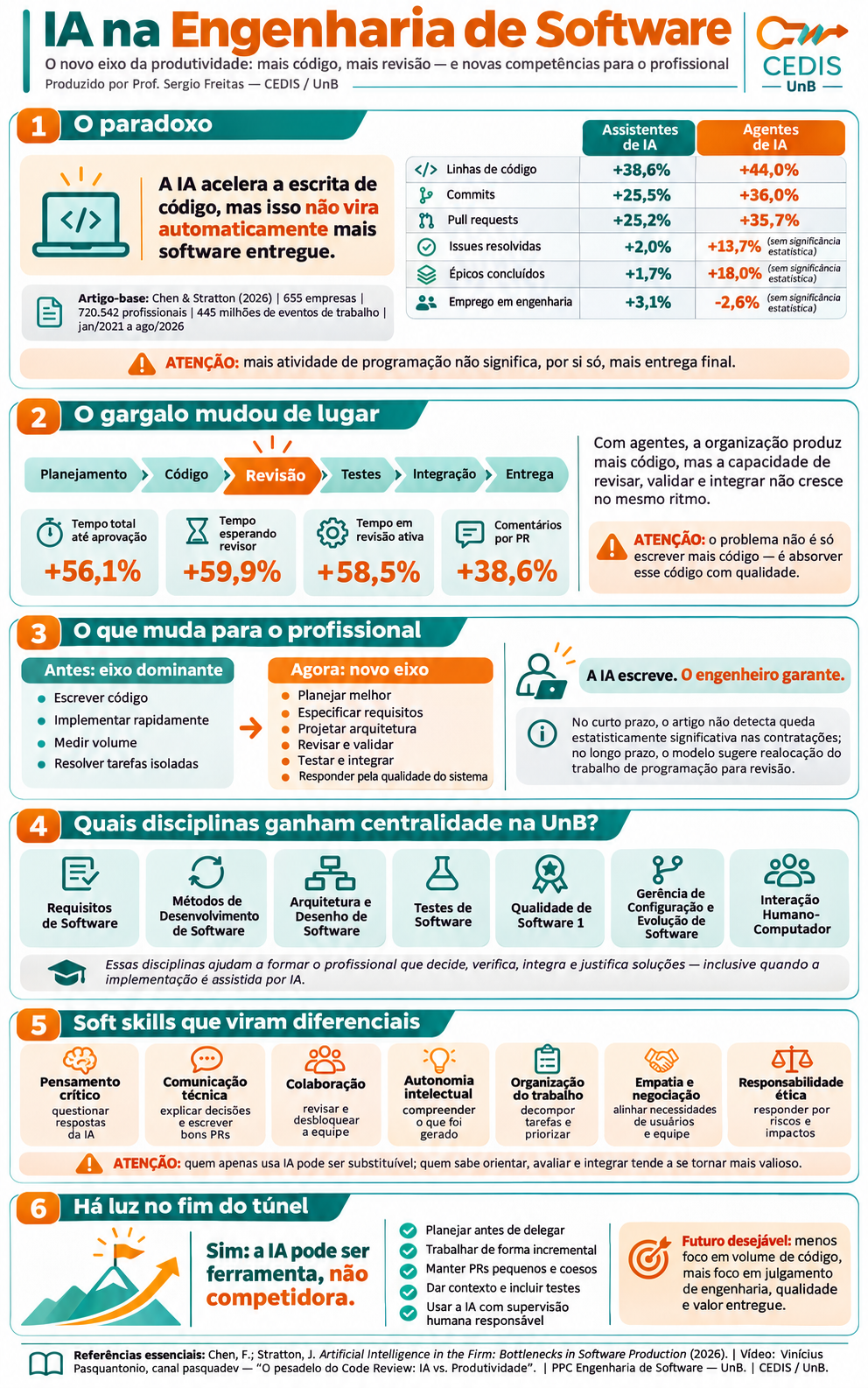
A Harvard working paper by Fiona Chen and James Stratton (Artificial Intelligence in the Firm: Bottlenecks in Software Production, version of 28 October 2026) tracks 445 million work events from 720,542 professionals in 655 firms. After the adoption of coding agents, lines of code rose 44%, commits 36% and pull requests 35.7% — but the increases in resolved issues and completed epics are not statistically significant. The bottleneck moved to code review: time to approval rose 56.1%, time waiting for a reviewer 59.9%, and 82.8% of reviews are still done by people who already knew the codebase.
In this piece, Sergio Freitas reads the study alongside a video by staff engineer Vinícius Pasquantonio and the Software Engineering curriculum at the University of Brasília, and argues that the profession’s axis is shifting from writing more code to deciding, verifying, integrating and delivering. Requirements, architecture, testing, software quality and configuration management gain centrality; so do critical thinking, technical communication and the responsibility for what gets merged. The piece grew out of a conversation with his Compilers students.
Materials (in Portuguese)
- Slide deck used in class (20 slides, PDF): A IA escreve. Quem garante? — O novo eixo da Engenharia de Software
- Infographic (PNG, high resolution): IA na Engenharia de Software — o novo eixo da produtividade
The views expressed in this piece are the authors' own and do not represent an institutional position of CEDIS or the University of Brasília.